7kg, 8kg or 9kg Used Washing Machine: What Size Do You Need?

The laundry basket is full, but that does not tell you how large a washing machine you need. A basket of shirts is different from a pile of towels or one bulky duvet.
Choose a used washing machine’s capacity around the loads you actually wash. Household size provides a starting point. Your washing schedule, fabrics and preferred programmes make the decision more useful.
Before paying extra for a larger machine, check whether its capacity helps with your normal laundry.
What does the kilogram rating mean?
The headline rating refers to dry laundry, under the model’s specified conditions. It is not the weight of clothes after they have absorbed water.
It also does not mean every programme accepts that amount. The programme table in the manual matters as much as the number on the front.
For example, Samsung’s cycle-capacity guidance shows different limits across wash programmes. Those example figures are not universal limits for every Samsung machine or UAE model.
Ask for the manual belonging to the exact used unit. A short cycle designed for a small load should not be treated as a full-capacity programme.
Use household size as a starting point
Samsung Gulf’s buying guide groups capacities around household size, while also considering available space and lifestyle.
That is useful for making a shortlist. It is less useful as a rigid rule.
Two people who wash gym clothes and towels frequently may have different needs from two people who send bulky laundry elsewhere. A larger household doing frequent small loads may also prioritise programme flexibility.
| Capacity to investigate | When it may deserve a place on your shortlist |
|---|---|
| 7kg | Smaller regular loads, with bulky items handled separately where needed |
| 8kg | A little more capacity for everyday loads that genuinely need it |
| 9kg | Larger compatible loads or a laundry routine that benefits from extra room |
| Above 9kg | Regular needs beyond the smaller models’ programme and item limits |
This is a selection aid, not a guarantee that a particular duvet fits. Confirm the chosen model’s instructions and your actual load requirements.

Measure a normal load before browsing
You do not need a complicated calculation. Record a few typical loads over a normal week.
Separate them as you usually would: everyday clothes, towels, bedding and delicate items. Do not combine incompatible fabrics just to fill a larger drum.
Weigh the dry laundry in a suitable container, subtracting the empty container’s weight. Use a scale safely within its rated capacity.
Write down the programme you would use and how often you wash that load. A simple worksheet makes shopping easier:
| Load | Dry weight | Programme needed | Frequency |
|---|---|---|---|
| Everyday clothes | Your measurement | Check garment labels | Your routine |
| Towels | Your measurement | Check the model manual | Your routine |
| Bedding | Weight plus item dimensions | Confirm bedding suitability | Your routine |
| Delicates | Your measurement | Programme-specific limit | Your routine |
Compare these notes with each shortlisted model. They are more informative than choosing capacity from the number of bedrooms in your home.
Look closely at the programme you use most
A machine may advertise a generous maximum capacity and a very short wash. Those two features may not apply together.
If you usually wash a few lightly soiled items before work, check the quick programme’s limit. If you wash larger cotton loads at weekends, check the appropriate cotton programme.
Also consider programme duration. A larger capacity does not automatically mean your weekly laundry finishes sooner.
Ask the seller to show the controls and provide the correct programme table. Do not rely on a product description copied from a similar-looking model.
Bedding needs more than a weight check
A duvet can be light and still occupy most of the drum. Check its care label and the washing machine’s instructions for that item type.
Do not force bedding into the machine because it falls below the headline kilogram rating. The permitted item size and loading guidance still matter.
Consider whether bulky bedding is a frequent need or an occasional one. Buying a larger appliance for rare loads may be worthwhile, but compare that choice with your usual washing routine.
The same caution applies to pillows, mats and unusual items. Suitability comes from the relevant instructions, not an assumption based on available space.
Compare two realistic routines
Imagine a couple who wash several small, sorted loads during the week. Their largest regular load fits the appropriate programme on a shortlisted 7kg machine. Paying more for 9kg may offer little practical benefit.
Now imagine a household whose usual compatible loads repeatedly exceed that smaller model’s programme limit. A larger machine may reduce splitting, provided its dimensions and condition also suit them.
These are hypothetical examples. Neither household size alone settles the choice, and neither example predicts electricity or water savings.
Use the worksheet to make the same comparison for your home.
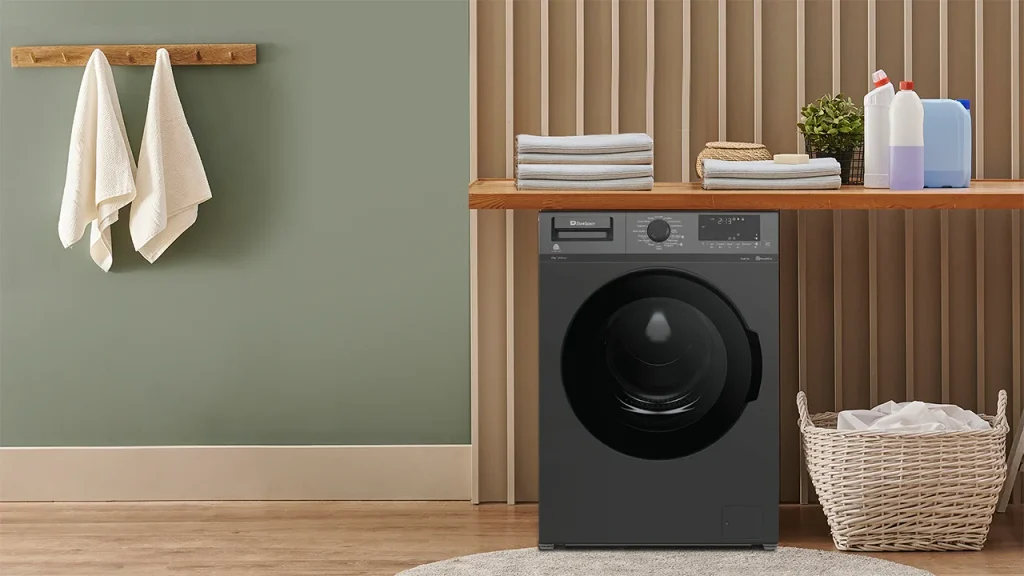
Do not confuse capacity with physical size
A larger capacity does not tell you the complete dimensions. Check width, height and depth for the exact machine, including projections specified by the manufacturer.
Allow for the door opening and the installation clearances. A front-loading door must open far enough for loading, not merely squeeze past the wall.
If access is tight, use our apartment delivery checklist. Measure the route as well as the final position.
Keep used-unit condition in the decision
A larger drum does not compensate for an unresolved fault. Compare service history, demonstrated operation and seller support alongside capacity.
For the broader inspection, read our used washing-machine buying guide. Keep capacity selection and condition assessment as separate checks.
If considering a washer-dryer combination, check its drying rating separately. Our combo-versus-separate guide explains how that affects the laundry workflow.
Avoid assuming the larger machine always uses more water or detergent for the same load. Consumption depends on the model, selected programme, sensing and dosing. Comparable manufacturer data is more useful than a general claim.
Send your requirements with the enquiry
Tell the seller your typical dry load, preferred programmes and available space. Mention any bedding you expect to wash at home.
Ask for the exact model, programme limits and evidence of operation. Confirm delivery, installation and support terms before reserving the unit.
Browse our used washers and dryers to build a shortlist. Choose the machine that fits your laundry routine and installation space, with a condition you can assess.